After years of post-COVID chaos, industry suppliers are telling us we can finally start expecting some calm in the summer of 2026. Don't bet on it.
2025 ridership figures are now available from both the National Sporting Goods Association and PeopleForBikes. And they both show historically high levels of participation in cycling.
So where are all the new bike sales? The answer is, at least some of them are trickling in in 2026. But the majority of riders, it seems, are still waiting.
The ridership devil is right where it always is, in the details. So let's take a closer look.
A look at the numbers
By definition, everyone who rides a bike has a bike to ride. And every one of those riders is potentially your customer.
Going back to 2010, the NSGA data shows a 44% decline in young (aged 7–17) riders the NSGA defines a "frequent" — that is, who rode more than six or more times per year — between 2010 and 2020, the first year of Covid. That's a steep drop. Fortunately, there was a 27% rebound during the post-COVID years between 2020 and 2025.
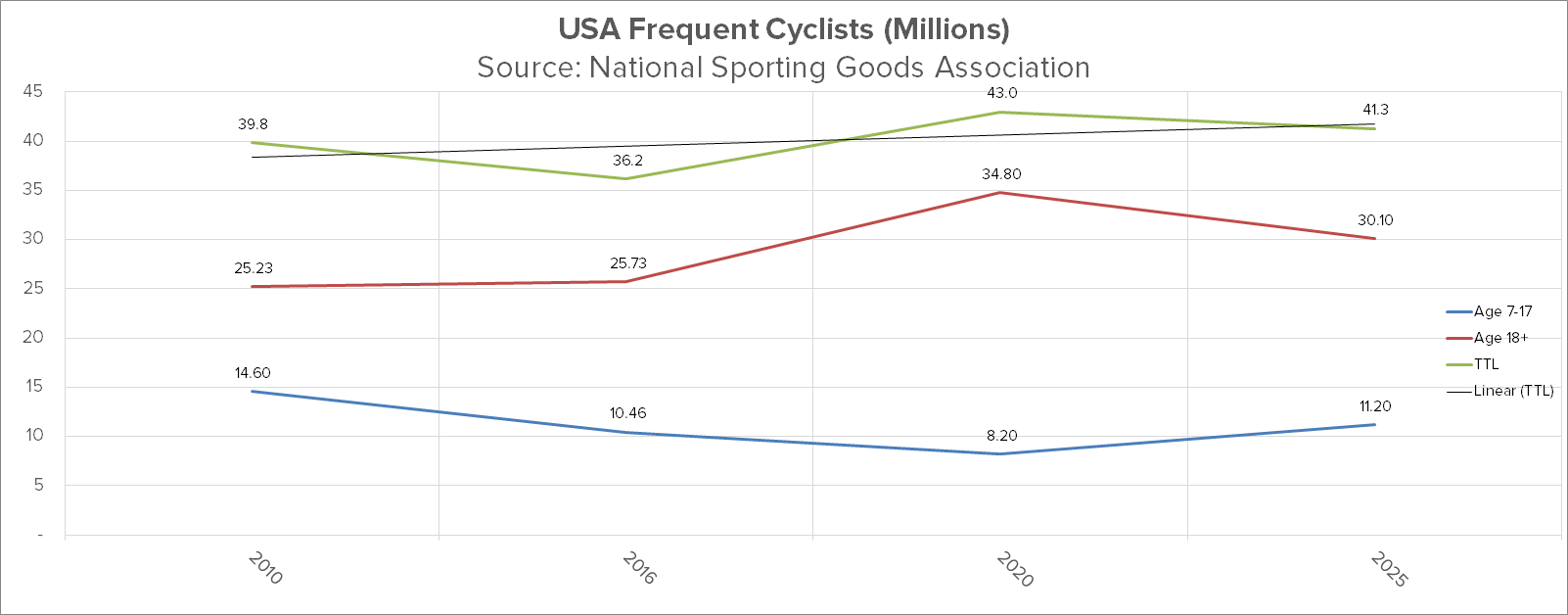
Also, fortunately, adult participation rose 16% between 2016 and 2020, tapering slightly from 34.8 to 30.1 million riders in 2025. Overall, the 41.3 million total number for 2025 was still higher than 2010; in fact, except for the 2020 Covid spike, 2025 shows higher ridership than at any time since 2000, which is long as I've been tracking the numbers.
Which ought to spell good news for industry fortunes going forward into 2026. More people on bikes automatically equals more new bike sales, right?
Well, maybe. Let's hold that question for a bit. Because the PeopleForBikes data offers some additional insights. Except it doesn't graph well, so here's the data in table form:
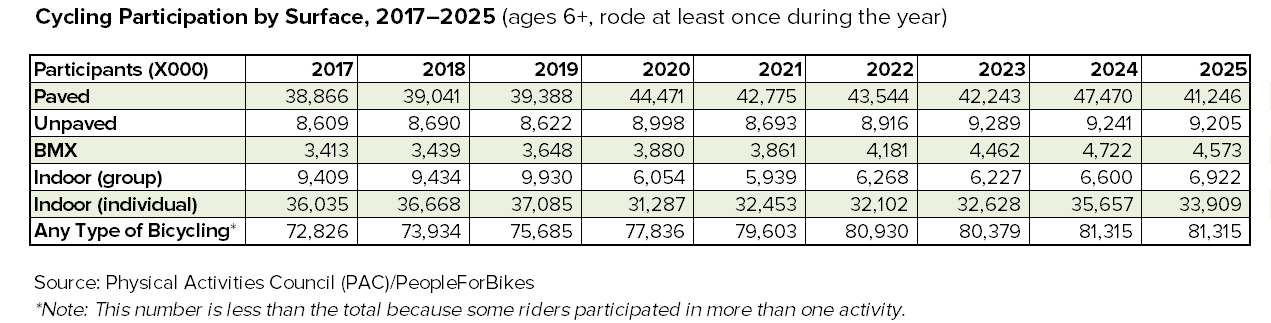
I should note here that P4B data includes anyone in the United States who rode a bike at any time and for any reason, which is why the numbers are so much higher than the NSGA's. Nothing wrong with that, it's just a different way of looking at the same picture. After all, by definition, everyone who rides a bike has a bike to ride. And every one of those riders is potentially your customer.
The P4B numbers show a 7% decline in paved riding versus 2020, offset by a surprising 19% increase in BMX, a 13% increase in group indoor rides, and a more modest 8% increase in individual indoor riding. Other metrics stayed essentially flat.
Overall, 2025 ridership was up slightly versus the 2020 Covid "boom" year (by 4%) with a total of 81,315 riders listed versus 2020's 77,836.
Any way you slice it, 2025 was a good year for ridership.
In search of the bottom line
That's not to say some of these new riders won't buy new bikes in 2026; they simply will do so at lower prices and at a lower turnover rate.
So what does all this mean for the remainder of the 2026 bike market? Not to mention the question of whether more people were riding in 2021–2025 than during the big COVID boom year of 2020, why weren't bike sales up during those years?
The answer lies in the PeopleForBike's data, and the fact that its numbers show more of a gain than the NSGA's. New participants coming into the activity during the COVID and post-COVID era tend to be casual and recreational riders (i.e., they ride less than six times per year).
Here's my point: Those new riders simply aren't buying new bikes at the same pricing or the same turnover as the enthusiasts we've been accustomed to in the '90s and early 2000s. That's not to say some of these new riders won't buy new bikes in 2026; they simply will do so at lower prices and at a lower turnover rate.
Bottom line: it's not just a new era, it's an entirely new market. And that's exactly why, if we expect to survive as an industry, that it's now more important than ever to reach out to everyday Americans and educate them about the health, fitness and just plain fun benefits of riding bikes.