BOULDER, Colo. (BRAIN) — Nearly a week after the 2026 Sea Otter Classic closed, I’ve absorbed an astonishing array of reports in the consumer and trade media, LinkedIn and elsewhere. Some is in line with my experience in Monterey, some not.
It was impossible to avoid a few of the big stories at Sea Otter. leading the way: 32-inch tires and the arrival of several Chinese brands (including X-Lab, which we wrote about before Sea Otter opened). If X-Lab showed a 32-inch e-MTB with radial-casing tires and AI-driven marketing, it would be so on-point that the industry’s thought leaders would have to shut up and find employment.
But as I did at the Taichung Bike Week last fall, I chose to spend my time in Monterey talking to industry leaders — current, past, and future — about large issues. While I plead guilty to trying on some shoes and ogling a few bikes, I mostly avoided the new-product egg hunt. For the new widget and product trend analysis, I would encourage you to check out the blanket coverage by BRAIN’s colleagues at Pinkbike and Velo.
I kept my notebook and camera in my pocket most times, and engaged in off-the-record on-background conversations, a privilege I decided to allow myself after a few decades on the BRAIN trust. When I changed my flight plans to enjoy an appointment-free final day, the stories really started to flow. Underneath the product talk, I heard thoughts about transitions and generational changes, on personal and industry-wide levels.
Why? It could be that an unusual spate of recent deaths of (mostly retired) industry leaders has got some of us of a certain age to thinking. It could be that as we emerge from winter and years of market challenges, folks are taking a breath and looking around. They/we are waking up to realize they/we are 8 years older than when Trump first threatened tariffs, launching a period of exponentially accelerating uncertainty.
It could be that the industry’s uncertainty finally reached what we’ve decided to call the “new normal,” a sustainable level of stress similar that of a school administrator character in a David Foster Wallace novel who attained what he called a state of “Total Worry” or “reverse-Buddhism.”
Or as one manager told me, “We decided to just get on with it.” I wrote that one down.
Make way for the new brands.
 Whatever the reason, after a few days under the posh Monterey sunshine, the industry was in a reflective mood. A mood of acceptance. Unprompted, the leaders of three significant brands told me their personal/professional plans for transitioning out of their companies. They are bringing on a new generation of talent: People who are more accepting that things aren’t done the same way anymore. In fact they may not even know how it used to be done.
On a larger scale, the brands of our younger days are not necessarily the brands of today. New generations of bike brands are arriving and others will inevitably fade away. It’s happening even faster on the e-bike motor and e-MTB side.
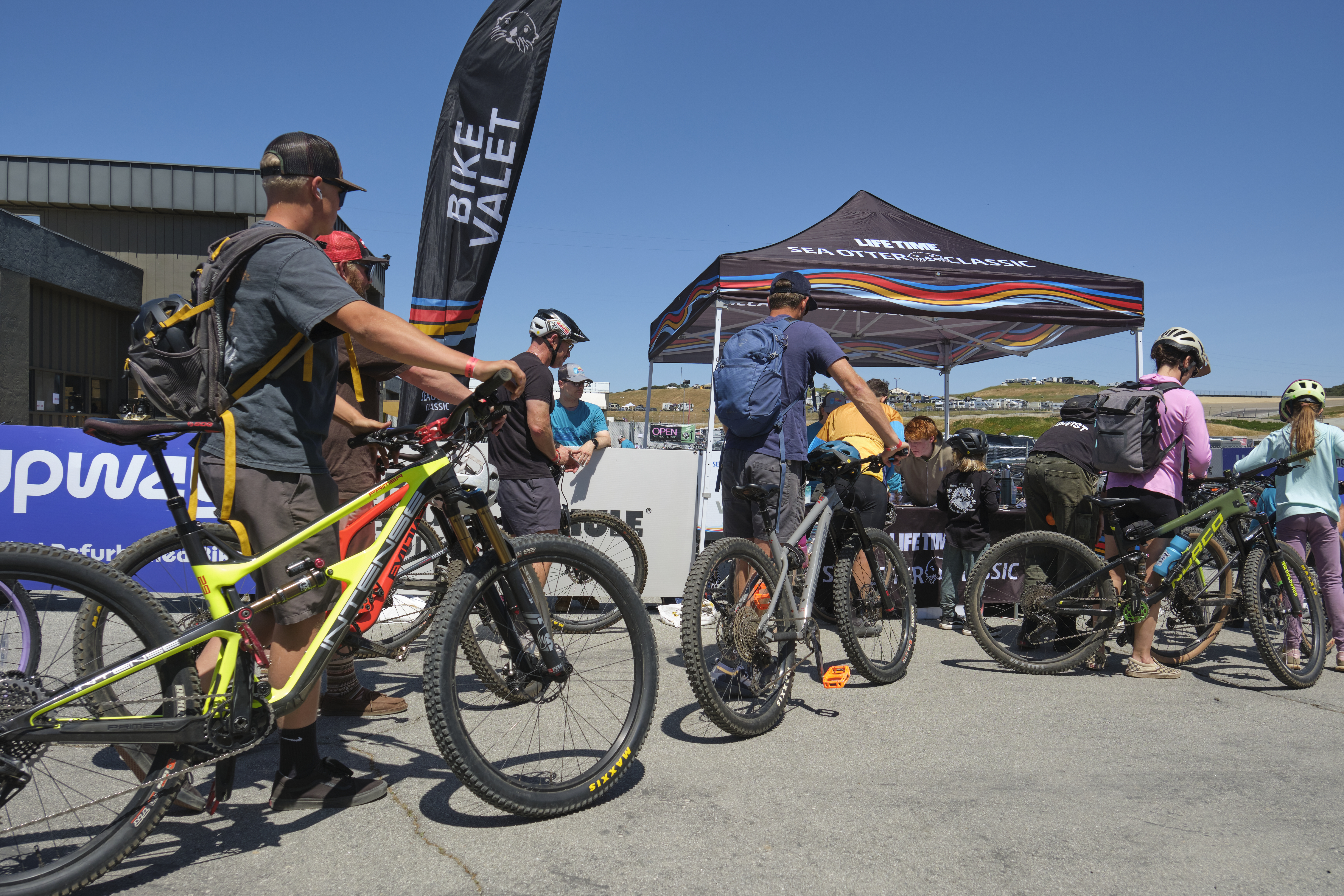
A mountain biker walking his steed across the Laguna Seca track at the end of Friday's event was overheard to say, "Do you remember when Trek was the biggest deal around? Back when Lance Armstrong rode their bikes?"
Not to pick on the brand, which is celebrating its 50th anniversary and which we suspect is kicking ass as always. But the rider was reacting to the fact that the Wisconsin brand did not have a display at Sea Otter this year.
Market shifts.
By now you’ve heard Sea Otter 2026 marked the arrival of several Chinese brands new to the market, including XDS/X-Lab, Avinox/Amflow and several component and suspension brands like Stablead. They may or may not be what we are talking about a few years from now. There was much discussion at Sea Otter about whether these brands are "buying marketshare," with plans to raise prices down the road. Others raised questions about longtime durability and retailer service from the new brands.
Many of these brands, as well as some European brands giving new attention to the U.S. market, are focused on sales through specialty retailers. That’s notable — not just because BRAIN’s traditional reader base is in bike shops, but because it’s a shift from the news we’ve been reporting for at least 10 years. These brands have learned from watching the market develop in recent years.
The days of the e-bike market being dominated by literally dozens of tiny D2C digital-only brands is over. The fate of the larger D2C brands, like Canyon and YT, is harder to predict.
I’m not privy to the numbers, but from discussions it’s clear what the new brands have learned from watching and experiencing the industry recently. They’ve calculated that running a consumer-direct sales operation, with the required inventory, customer service/warranty, marketing and sales expenses, is more expensive and less effective than handing off some of those costs to independent retailers. They talk about retail “touch points” and how bike shops are the “heart of cycling,” but don’t fool yourselves, it’s simple math. Longtime dealers may have to adapt to a modern, corporate, and expensive, approach to the customer service they receive from their vendors. In that area and others they might be soon longing for the good old days. Younger dealers may have no issues with the new standards.
In another shift, the global industry is looking at the U.S. market a different way. X-Lab is handling much of its product development from California, and said it will continue that even as it moves into Europe and other markets. Meanwhile fellow Chinese brands like Avinox and Amflow have a lighter presence in the U.S. All the Chinese brands benefit from having a direct connection to their factories, reducing costs and allowing them to move faster, without a U.S. office with dozens or hundreds of employees.
While these brands are paying attention to the U.S. market, they are also thinking globally. They see that the U.S. is a trend-setter in some areas, but very challenging in other ways. They have certainly looked at public reports from Giant and Shimano showing a decreased reliance on the U.S. market: Since 2015, Shimano’s sales in North America have gone from 8% of its business to less than 6%. Giant's sales in the Americas have fallen from 21% of the the company's global revenue in 2019 to 8.6% in 2024, according to the company's 2024 annual report.